
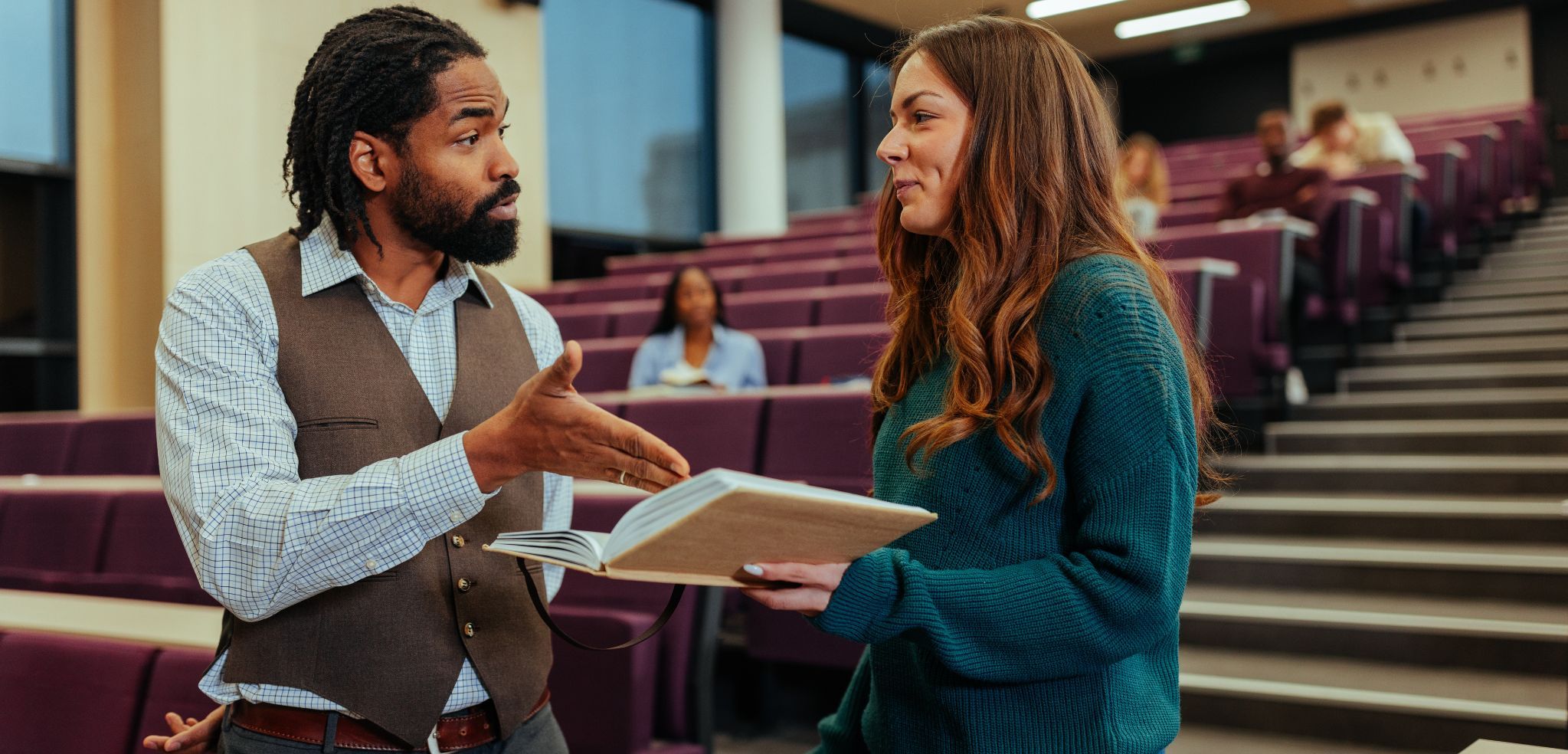

Two of my past articles for The Teaching Professor describe different types of educational “moments”: teaching moments and critical moments. Although I have been in the classroom for nearly 35 years, I continue to seek out strategies, like these moments, to fine-tune my teaching. In fact, I recognized years ago that there is always room for improvement. Recently, however, to my chagrin, I belatedly realized that an obvious way to be a better teacher had been right in front of me my whole career but I never took full advantage of it. It involves what I have dubbed “sharing moments.” Whereas teaching moments and critical moments are strategies that teachers would usually employ during class discussion, sharing moments are more personal and tend to take place with students one-on-one, often just after class. Although brief, their value can be immense, particularly in terms of building meaningful relationships with students.
What are sharing moments? They are moments when a student excitedly shares some insight or some personal experience related to a reading or to class discussion. Unfortunately, until my recent and long-overdue recognition of how meaningful these moments can be, I never really nurtured them. As teachers, when a class ends, we’re often in a hurry to get to the next class or back to our offices, where the work related to teaching, such as grading or recordkeeping or email, always awaits. Consequently, we may feel that we cannot spare a minute or two after class to listen to students and to appreciate what these moments mean to them. It was fall 2025 when I suddenly realized that I had been woefully underappreciating the many opportunities I had had over my long career to engage with students during sharing moments.
My students and I were reading The Daodejing in a section of one of the courses I teach, Intellectual Heritage I: The Good Life, a critical thinking and reading course that focuses mainly on works of literature and religion. As I was introducing the text, I told the students a story that a former colleague had told me many years ago to help illustrate a Daoist perspective. In brief, it’s about a young man who breaks his leg while out riding a horse. When his father finds him, the young man is distraught over his grievous injury. The father tells him not to assume that the injury is necessarily a bad thing. The next day, troops come through their village, conscripting young men, and the young man cannot go because of his broken leg. I have told this story many times over the years. On this occasion, however, a student came up to me after class and asked whether I knew the rest of the story. Intrigued, I said no. The student proceeded to tell me a much richer version of the story than the abridged version I had heard from my colleague. Of course, I came away from the conversation better informed. More important, I noticed how delighted the student was to share a more complete version of the story with me, and I realized that this encounter between teacher and student, which lasted only a few minutes, was nonetheless much more consequential than a simple conversation. It reaffirmed for me that teachers and students share the learning experience, and I fully believe that my interest in what she was saying reaffirmed for my student that her voice and her knowledge have pedagogical value. In other words, this brief conversation was time well spent.
More than a decade ago, in another section of Intellectual Heritage I, I was teaching Charles Baudelaire’s Paris Spleen. After class one day, a student came up to me, held up the book and said, “I like this guy!” The comment has stuck with me because it was impromptu and because of the broad, genuine smile the student had on his face when he made it. I don’t recall whether I had to rush to another class or felt I had to get to my office, but unfortunately I didn’t nurture the moment. I said something along the lines of “I’m glad to hear it!” and hurried on my way. As I look back, I realize that I could easily have spared a few minutes to speak to the student more fully about why he liked Baudelaire so much. I could have said, “Wonderful! What is it about Baudelaire that you enjoy?” A short conversation about his experience with Baudelaire would have been meaningful to both of us. Sadly, I missed a golden opportunity to nurture the student’s excitement and, perhaps, learn something about Baudelaire that my student saw and that I had missed.
There are, of course, other ways besides sharing moments to build meaningful relationships with students. But these brief moments have value for both teacher and student well beyond their limited duration. They reaffirm that the learning process is a two-way street, and they reinforce for students that their insights matter.
John A. Dern is a professor of instruction in the Intellectual Heritage Program at Temple University in Philadelphia. A teacher since 1991, he received the 2009 Violet B. Ketels Award for teaching from the Intellectual Heritage Program and the 2017 College of Liberal Arts Teaching/Instructional Faculty Award.
The post Nurturing Sharing Moments appeared first on The Teaching Professor.