
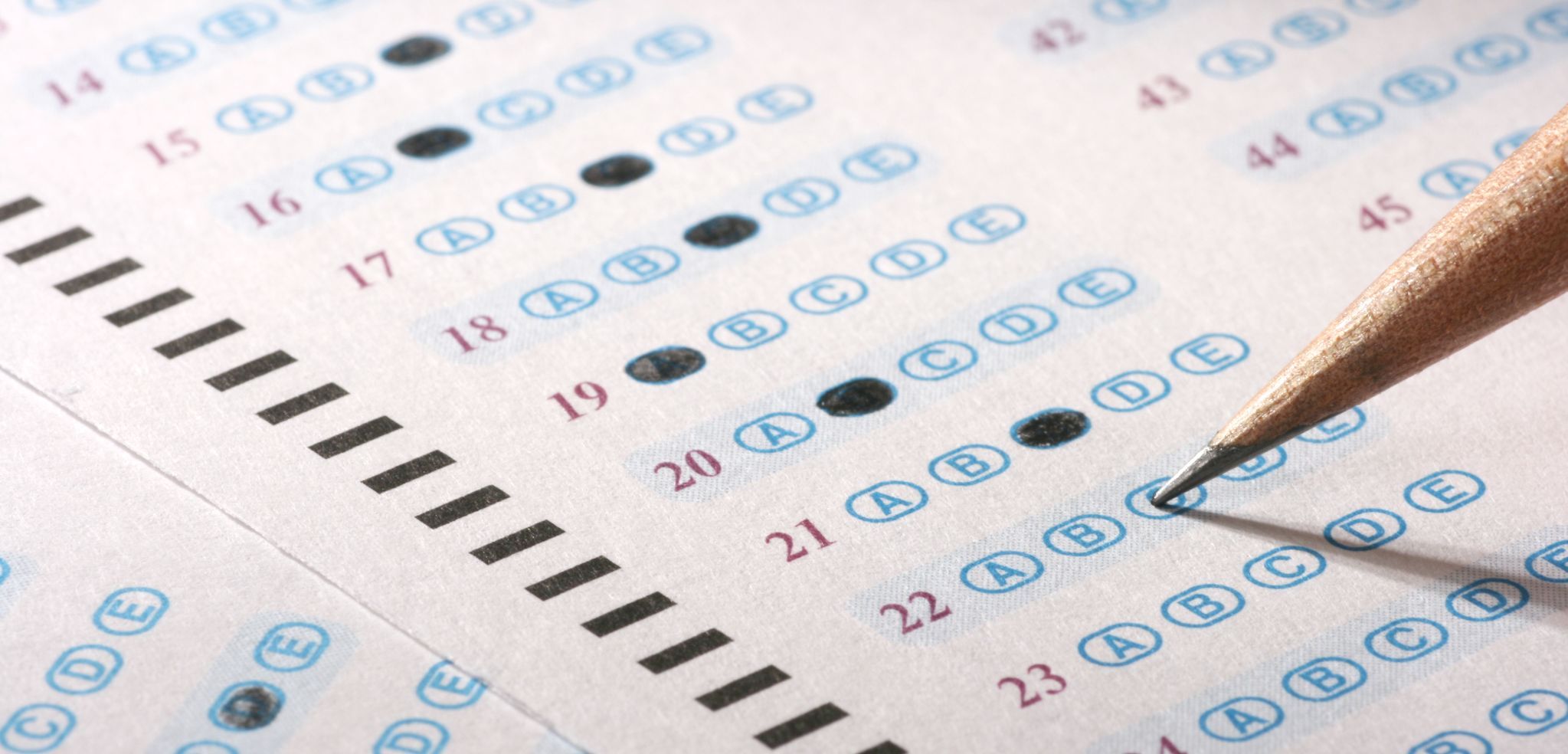

“The Song Remains the Same,” a tune penned by Robert Plant, the energetic lead singer of Led Zeppelin, has a basic message: Even in the face of the passage of time or world events, core elements of life stay constant. That sounds like how we view multiple-choice (MC) exams. Regardless of the many ways higher ed has changed in recent years, instructors, especially in large, introductory-level survey courses, have continued to use MC exams. While not always problematic, how we use MC exams needs some reflection. And the song need not remain the same.
For many years, I used MC exams in every class I taught. It seemed to make especially good sense for my large introductory psychology classes with 250 and then 400 students. On exam day I’d print out close to 2,000 double-sided sheets of paper. Students put their names on their Scantron forms and, under my watchful eyes, aimed to demonstrate their learning in the minutes allocated to the assessment. Ten years ago I made a major change: I made all exams online. Five years ago I made two more big tweaks: Exams became open book, and students could take them anytime within a designated window (albeit for a fixed period once they started).
Many balk when I share these changes. Most assume students will cheat. I monitored the effect of each change and can report that the average scores on my exams did not change significantly. I did not see a ceiling effect with every student scoring in the high 90s or maxing out. I see variance in exam scores, and students still fail. Most students don’t use all the time allocated to the exam, often taking an average of about 30 minutes to complete a 50-minute, 50-question exam. If students haven’t studied and don’t know what information is where, these completion averages don’t suggest that there’s enough time to cut and paste from AI. To be fair, I use evidence-based practices for writing exam questions (Zimmaro, 2016) and take pains to write exams that climb Bloom’s taxonomy (Crowe et al., 2008) and relate to classroom lectures. I also examine and improve questions in publisher-provided test banks as needed. If you have not considered changing how you write and administer exams, here are some key considerations.
Going open book
This may be the toughest idea to wrap your mind around. Traditionally, learning is measured by students showing what they remembered with no recourse to study materials. While the data on closed- and open-book exams is mixed (Agarwal et al., 2008), our perceptions of the benefits of closed-book exams may not match reality. For example, one systematic review of studies in medicine classes showed faculty expect students to prepare more for closed-book exams and perform better, but this isn’t necessarily the case (Durning et al., 2016).
Open-book exams may enable deeper level learning with less commitment to short-term memory, reduce negative effects of anxiety, enable a wider level of assessment, and be more representative of certain professional settings (Green et al., 2016). In one lab study, open-book exams were as effective as the closed-book variety in producing learning gains even after a two-week delay (Wenzel et al., 2022). Closed-book exams do not seem to encourage deeper learning, as students, not having access to course material, focus more on memorizing facts (Cheng & Selvaretnam, 2022).
There is some evidence that closed-book exams have benefits, but such studies are limited. Students in introductory psychology classes took either open- or closed-book preparatory exams for a small percentage of the total grade. These exams were followed by two surprise closed-book exams separated by two weeks. Both exams mostly required retrieval of information, and students who had taken closed-book preparatory exams performed better (Rummer et al., 2019).
Using untimed tests
As with open-book tests, faculty often stay away from untimed tests. It’s easy to think that, given unlimited time, students may cheat. But research shows that especially for students from nondominant cultures, removing the time pressure can reduce stress (Tibubos et al., 2025). In fact, changing your exam format to not limit time will allow you to focus on asking better questions, such as those calling for higher-order thinking and more critical thinking and those with answers that students cannot simply look up or glean from AI. It gets better. Untimed tests may even provide more accurate assessments of learning. In a review of the research on timed and untimed exams, Gernsbacher et al. (2020) provide four empirically based reasons go the route of untimed exams. The authors claim that time-limited exams are (a) less valid as the speed at which students take an exam does not reflect their mastery of content or knowledge; (b) less reliable as estimates are not indicators of student knowledge but artifacts of the testing; (c) less inclusive, excluding students with documented disabilities; and (d) less equitable, creating barriers for multilingual students and certain sociodemographic groups.
Trying collaborative exams
Given that many careers involve collaboration and group work, students working together on an exam should give that good preparation for life after college. Unfortunately, faculty treat collaborating on an exam as cheating as it is often explicitly not allowed. The arguments against collaboration make sense: Students with low motivation may capitalize on the hard work of others, and such exams may be logistic nightmares to administer. But studies of collaborative exams show that they often lead to greater learning (Jang et al., 2017). An early study comparing taking tests in introductory psychology classes with a partner with taking them alone showed that collaboration increased test scores, reduced text anxiety, elevated confidence, and increased students’ enjoyment of the course content (Zimbardo et al., 2003). Different explorations of two-stage exams, where students first attempt questions alone and then have a chance to discuss questions with others, demonstrate the learning benefits of group discussions (Bruno et al., 2017). In one review of 16 studies comparing traditional individual exams and collaborative exams, exams scores were higher in collaborative formats in a majority of comparisons (Efu, 2019).
How will AI use influence each of these different formats of exams? It’s too early to tell. Yes, you can use printed exams and Scantrons and proctor timed exams to minimize academic dishonesty, but with the evidence in favor of alternate delivery methods, each is worth our consideration.
Regan A. R. Gurung is professor of psychological science at Oregon State University. His latest books are Teach Like a Champ and Thriving in Academia. Follow him on LinkedIn.
The post The Song Need Not Remain the Same: Considerations for Multiple-Choice Exams appeared first on The Teaching Professor.