


As July fades into August, faculty across the country gear up for the fall semester. We have spent our summer resting and relaxing, reading, and mentally preparing to welcome a new cohort of students into our classrooms. This is about the time when we scan our files for past icebreakers—for our favorite experiences that get students talking, help us introduce group norms, surface commonalities among learners, and invite dialogue and conversation into our new spaces and contexts.
But the reality is that our students are tired of traditional icebreakers. They don’t want to play another meaningless game that forces them to share trivial information about themselves. They want genuine connection—the opportunity to share aspects of their identity with others, to feel accepted, known, valued, and seen within a community of their peers. They want authentic relationships.
Noddings (2013) describes how authentic, caring relationships have roots in responsiveness, receptivity, and attention to the other person’s needs. These types of relationships do not happen by accident. We must cultivate them through the repeated integration of belonging-based pedagogies that emphasize identity, agency, and personal and communal connections (Kuttner, 2023).
In these classrooms, belonging is a right rather than a privilege, and experiences that center students’ strengths, identities, and interests actively foster it. When students see themselves, their histories, their cultures, and their communities reflected and honored in the classroom, we create the conditions for joy. Muhammad (2023) describes joy as more than happiness or celebration. It is a state of wellness, beauty, healing, and justice that nurtures both individual and collective humanity. For educators, the cultivation of joy in the classroom is not accomplished through a single strategy but the “patient work of building the conditions that uphold each other’s dignity.” This approach to community-building can core educational and pedagogical pursuit begin on the first day of the semester.
It’s not enough to say we care about learners. Our actions, exemplified through the construction of our learning experiences, must align with our words in ways that our students recognize and value by our students. I humbly share my students’ favorite first-day activity: heART. As you can see, the word “art” is embedded in the word “heart.” When learners walk into the room, they are provided with a cardstock cutout of a heart. The initial prompt is simple: Fill your heart with things that bring you joy. Students get five minutes to individually fill a paper heart (using a combination of words and pictures) with people, places, memories, and experiences that matter to them. Faculty can easily adapt this activity to an online learning environment by creating a Google Slides deck where each learner can digitally add images to a heart graphic on their own slide. The examples below represent the heARTs of both an in-person and a virtual student of mine.
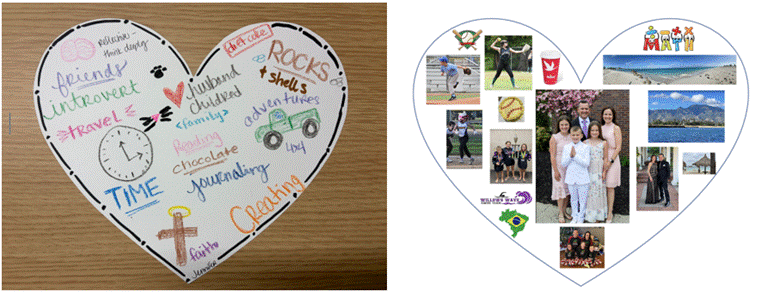
After their design time is complete, students should display and share the heARTs. There are many interactive and discussion-based protocols for accomplishing this. For example, simple protocols like a turn and talk or a world café allow students to briefly discuss their heART with a partner. More complex protocols, like affinity mapping or a carousel, can be used to translate multiple points of connections across groups into larger universal themes. If students are virtual, they can engage in a digital gallery walk to explore the heARTs of their classmates. In-person students, similarly, can place their hearts on tables and walk from heart to heart. Once everyone has viewed their classmates’ hearts, it’s time to share. bell hooks (1994) argues that authentic learning relationships require reciprocity. Educators cannot ask students to be vulnerable, engaged, and fully present if they themselves refuse to share aspects of their own experiences and identities. It is critical that we, the facilitators in the room, model the process by sharing first. It might sound like this: “My name is Jessica. I go by Jess. I was raised in Maryland and spent my summers at the beach on the Eastern Shore. I placed the ocean on my heart because being near water makes me feel calm and centered. Living in Arizona, I miss the ocean.”
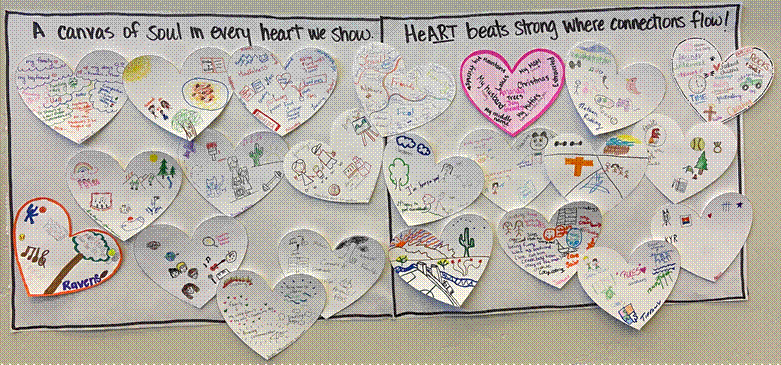
I share one item from my heart, then tape it to the board. Any student who makes a connection, in some way, to my item goes next and shares one item from their heart. They place their heart on the board, and the procedure repeats until every person has shared. In a virtual classroom, students can join small breakout groups (four to five students) on Zoom or Teams to make connections with others while viewing their heARTs in Google Slides. I only have 23 students in each class. A whole-group share-out like this takes about six to 10 minutes. For classes of 100-plus learners, consider breaking students into small groups. They can employ the same protocol for sharing internally with their group, then post their hearts to the class wall. This protocol provides all learners with an opportunity to see the hearts of classmates not in their small group. The image below documents the heART wall from a 2025–26 cohort of residents enrolled in a graduate teacher residency program in Arizona..
In addition to being connective, this experience is reflective. After sharing their connections, students spend a few minutes journaling their responses to a prompt: How did exploring both your heART and the heARTs of others influence your sense of belonging in this space? A past student beautifully captured the purpose and impact of this experience: “Having my heart on the wall made me feel good. It told me that I was important in this space . . . that my teacher cared enough to display my artwork, and that my classmates could begin to see the things that make me . . . ME.” As students reflect on themselves and the stories of others, they begin to move from simple introductions and surface-level connections to an authentic and supportive learning community (Jagers et al., 2019).
The shift from traditional first-day-of-class icebreakers to experiences that lead with heART is simple yet profound. When we do this, we are creating a framework for relationships that becomes the foundation for future learning. We are building classrooms to intentionally become spaces of belonging and joythat serve students notonly for the semester but for a lifetime.
References
hooks, b. (1994). Teaching to transgress: Education as the practice of freedom. Routledge.
Jagers, R. J., Rivas-Drake, D., & Williams, B. (2019). Transformative social and emotional learning: Toward SEL in service of educational equity and excellence. Educational Psychologist, 54(3), 162–184. https://doi.org/10.1080/00461520.2019.1623032
Kuttner, P. J. (2023). The right to belong in school: A critical, transdisciplinary conceptualization of school belonging. AERA Open. https://doi.org/10.1177/23328584231183407
Muhammad, G. (2023). Unearthing joy: A guide to culturally and historically responsive teaching and learning. Scholastic.
Noddings, N. (2013). Caring: A relational approach to ethics and moral education (2nd ed.). University of California Press.
Jessica Manzone is an assistant professor of teaching in the College of Education at Northern Arizona University. She currently serves as lead faculty for the Arizona Teacher Residency and is the co–principal investigator for a five-year US Department of Education Education Innovation Research grant to study relationship-based teacher residencies.
The post Leading with HeART: Building Relationships from Day One appeared first on The Teaching Professor.