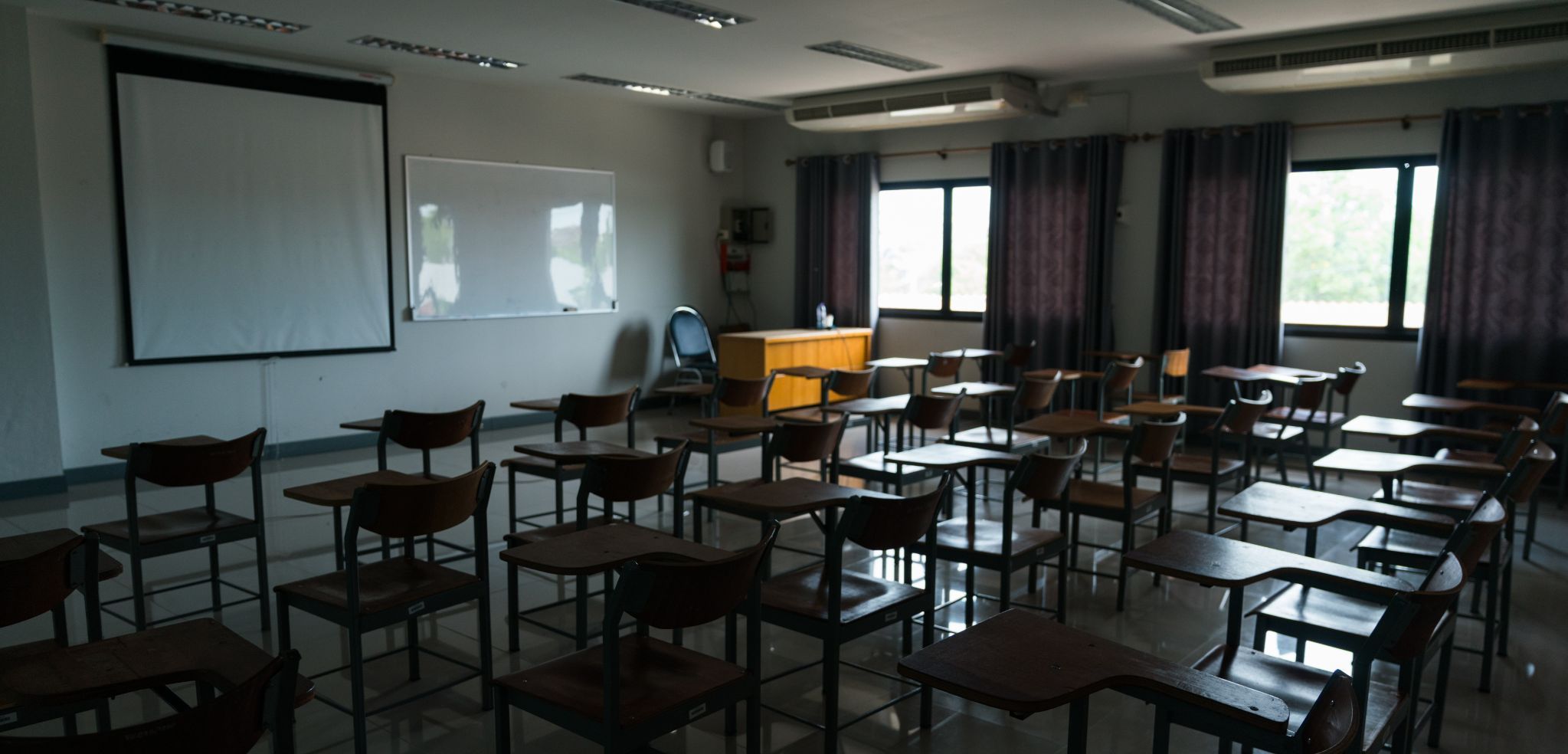

Do a little recon when courses begin next semester. Is there an empty classroom nearby? That vacant space is pure pedagogical potential, and it’s a shame to let it sit unused. Here are five ways that I use that spare room to level up my teaching.
Break zone
Classrooms can be loud, bright, fast-moving places, which makes them difficult to navigate for students with sensory sensitivities. I wish decompression rooms were universal features of all campuses, but we’re not there yet. In the meantime, a nearby space that students can step into for a few minutes offers a small, practical way to take a break. I let students know early in the semester that if they need to step out, they’re welcome to use the room next door and return when they’re ready—no explanation required. Framing this practice as a built-in accommodation helps students use it without feeling singled out.
The adjacent space has also become a quiet refuge for student needs that I hadn’t anticipated: pumping breast milk, checking blood sugar, or simply sitting in the dim room when a migraine begins to set in.
Additionally, an extra room makes it easier to include movement breaks and brief meditation exercises in class. Many instructors do this well without a second space, but having one next door means fewer desks, backpacks, and bodies to navigate. In my experience, that added breathing room—and the sense of fewer eyes on them—can make students feel less self-conscious during these activities.
Simulation lab
Added space allows role-playing or immersive classroom activities to unfold on a larger scale. When I teach The Canterbury Tales, for example, students build stations that mimic the hazards and rituals of medieval pilgrimage, from burglary and false relics to acts of penance, and moving from one room to the next helps them feel the cumulative distance of the journey.
For texts structured around sharply contrasting worlds, such as city and country in The Importance of Being Earnest and heaven and hell in Paradise Lost, I ask students to remake the rooms so that each space runs on visibly different rules.
For instance, when I teach A Midsummer Night’s Dream, I divide the class in half and ask one group to create the stiff, orderly feel of Athens—desks in rows, a fixed front—while the other transforms the room next door into Midsummer’s chaotic forest: desks pushed into winding paths, chairs scattered, cryptic fragments from the lovers’ quarrels and fairy speeches written across the whiteboards. That simple shift in space helps students experience what the play itself does: Move from order into misrule.
But the cleverest uses of the spare room have come directly from students. Last semester, one group explored how Shakespeare’s staging changed when he moved from the Globe’s rowdy, open-air performance space to the intimate Blackfriars Theatre later in his career. In one room, students recreated the Globe with bright lights and a tightly packed audience; in the other, they dimmed the lighting and carved out a smaller, enclosed playing space. With Henry V’s “Once more unto the breach” as their test case, students first played the speech broadly for the Globe, projecting outward to a noisy crowd, then reworked it for Blackfriars as something quieter, as if we were overhearing a hushed conversation among soldiers.
A different student group became fascinated by how often Shakespeare’s plots hinge on letters gone astray, so they used the spare room to stage those failures in real time. One space became the point of origin, where students drafted letters like Friar Laurence’s note to Romeo, while the room next door introduced obstacles to delivery: blocked pathways, designated “watchers,” and students tasked with interference. As letters moved physically across rooms, some arrived, some disappeared, and some came mere seconds too late. Suddenly, what can seem like a clunky plot device felt genuinely suspenseful.
Rehearsal hall
The room next door gives students space to test choices before bringing them onto the main stage.
Some performers simply need fewer ears on them during rehearsal. I’ve watched students who barely spoke above a murmur in class suddenly project with full force in the vacant room. Out of earshot, they seem freer to test possibilities—different pacing, bolder blocking choices—without the self-consciousness that can come with rehearsing in front of everyone. By the time they return to our assigned room, their performance carries a new sense of confidence.
Some theatrical moments lose their force if everyone watches them being rehearsed, so I often send groups next door to work out scenes that rely on surprise: Banquo’s ghost appearing without warning, Lady Macbeth peeling off her gloves to reveal blood-soaked hands, or a newly blinded Gloucester being led through the audience. I still remember a Julius Caesar performance in which two members of the men’s powerlifting team suddenly rose from opposite sides of the room and pinned Caesar’s arms as the conspirators closed in. The spare room allows students to rehearse those reveals in secret, so they retain their power to startle.
Surprise can also be a powerful teaching tool. Once, after we finished Othello, my students completed a group project in which they put the title character on trial for Desdemona’s death. While they were settling into the main classroom, I had secretly enlisted a panel of colleagues—wearing full academic regalia—to wait in the spare room; at the appointed moment, we crossed the hall and opened the door to reveal our makeshift tribunal. The students were startled, then delighted. The room’s separateness lent the whole scene a ceremonial, almost theatrical intensity.
Split-level studio
Most of my literature courses serve two distinct populations: 200-level general education students and 300-level English majors. We spend most days in the same classroom, but there are moments when the extra space becomes especially useful. On workshop days, for example, I’ll send the 300-level majors next door to peer-review one another’s drafts, while the 200-level students remain in our usual room to focus on close reading or collaborative group projects. I move between the two rooms, touching base with each group as they work.
The extra room also helps manage the uneven rhythms of the writing process. Even when students are working on the same assignment, they rarely arrive at the same stage at the same time, so I often use the two rooms to separate phases of the work: one space for brainstorming and outlining, the other for revising drafts.
Sometimes differentiation has more to do with the classroom environment than with content. Last semester when my senior seminar students were memorizing Shakespearean passages, I designated one room as a quiet zone and the other as a more conversational space. Students chose the setting that best supported their process: The ones who needed complete silence took their texts next door to perform uninterrupted reps with the language; others stayed in the main classroom with a partner acting as prompter. The right room made all the difference.
Reset room
Every classroom acquires a kind of muscle memory. Students know where to drop their bags, when to speak up, and which corners of the room they have gradually made their own. Sometimes that familiarity is comforting.
But sometimes familiarity breeds inertia; the room can begin to feel as though we’re just going through the motions. On those days, I move the class next door: “Bring your course packs. We need different air.” The line usually gets a laugh and, just as often, a grumble or two as students gather laptops, coffee cups, and backpacks.
The shift is almost immediate. What had begun to seem overfamiliar starts to feel fresh again. Even the sound of the language changes; Shakespeare’s words, heard in another room, often recover the strangeness that routine had worn away.
Just last week, a lagging discussion of Gertrude’s role in Hamlet suddenly sharpened once we crossed the hall. From the back corner, my student, Sylvie, asked, “What if she knows exactly what Claudius has done and just can’t afford to say it?”
Then she let out a quiet chuckle, looked around the room, and said—almost to herself—“I guess I can think better in here.”
Nichole DeWall is a professor of English at McKendree University in Lebanon, Illinois, where she teaches Shakespeare, medieval and early modern literature, drama, and composition courses.
The post The Spare Room Advantage appeared first on The Teaching Professor.