


Cramming is an alluring but risky study strategy. Let me explain. By the time students get to college, they probably have a lot of experience cramming for exams and likely have a good record of success using it as a study strategy. By cramming, I mean delaying exam preparation until the last possible moment and then studying material intensively. I do not mean studying ahead of time and then intensifying study just before the exam. Cramming is waiting until the last minute to study; it is not studying up until the last minute. It is often the result of procrastination, poor planning, or prioritizing other activities over studying, but multiple studies of student study habits show that a sizeable number of students see it as a useful study strategy that they employ voluntarily, even without external demands and pressures (Hora & Oleson, 2017; McIntyre & Munson, 2008; Theobald et al., 2021; Vacha & McBride, 1993).
While many faculty believe that cramming is a poor study strategy, that is a bit of a misconception. Cramming can be effective, but only for short-term learning and only if the material is easily understandable. It’s hard to find careful experiments looking specifically at the effectiveness of cramming on learning, but cramming is a form of massed practice—that is, concentrating all studying at one time—and there is a large body of research comparing massed practice to other learning strategies, such as spaced practice. Rohrer and Taylor (2006) carried out such a study on math knowledge. The spaced group broke up their studying over two sessions one week apart while the massed group completed the same amount of studying in one session. Rohrer and Taylor tested learning at two time periods: one week after studying and four weeks after studying. The results appear in Figure 1 below. At one week, massed practice was actually slightly better than spaced practice, but at four weeks, spaced practice was clearly better. This pattern of results is typical for spaced versus massed practice. The two strategies are equivalent in the short run, but spaced practice is clearly better for long-term learning (Carpenter et al., 2012; see also McIntyre & Munson, 2008). In other words, cramming leads to rapid forgetting.
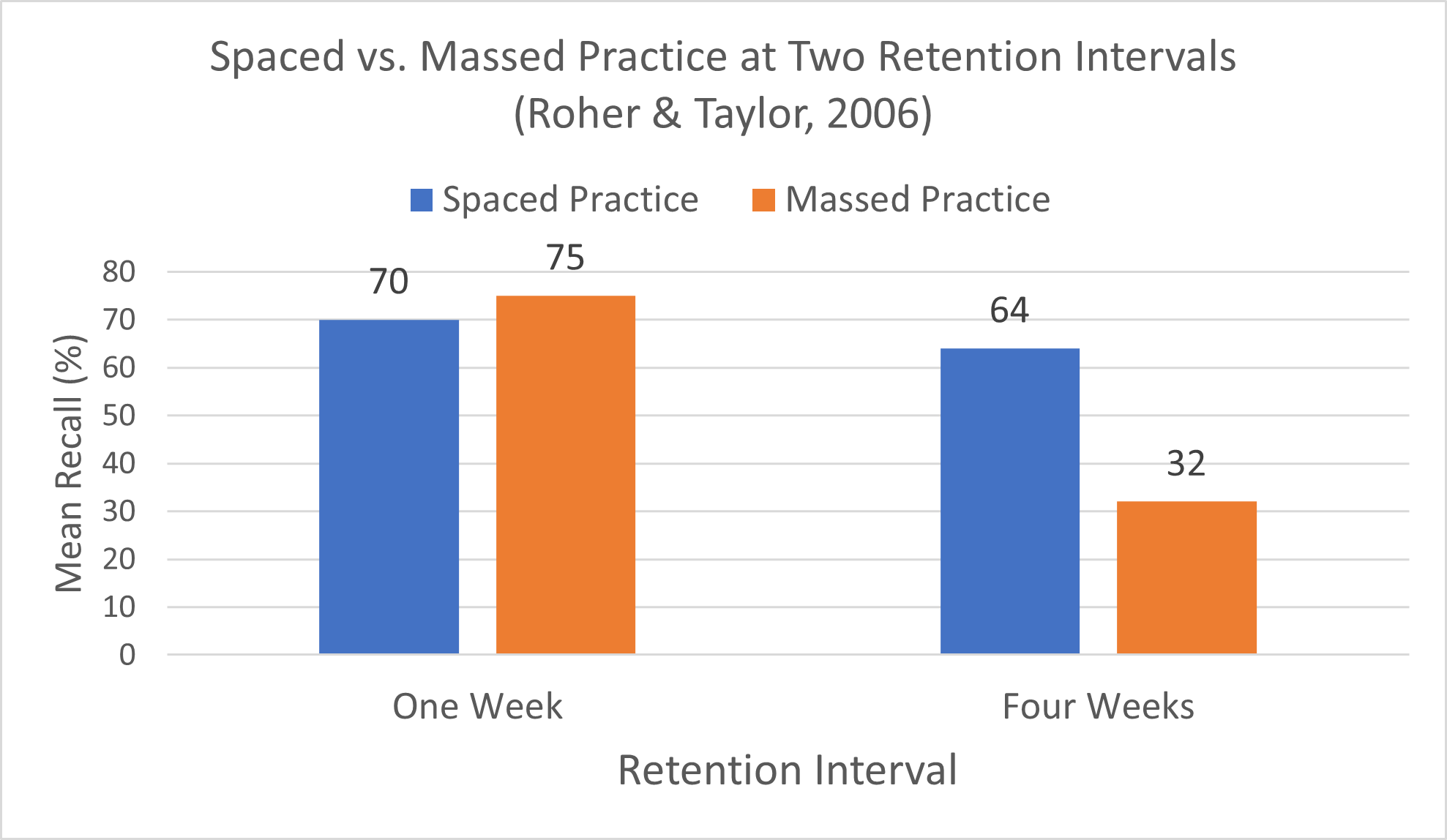
Figure 1. Mean recall of math knowledge based on spaced or massed study at one- and four-week retention intervals.
It is easy to see why students like cramming, especially if they find studying boring or tedious. Cramming concentrates the unpleasantness of studying into a short period, freeing up students to engage in more enjoyable activities most of the time, and still allows students to learn enough to pass exams. The fact that it is a poor long-term learning strategy doesn’t matter to students if passing an upcoming exam is their main priority. It is not surprising, then, that McIntyre and Munson (2008) found that almost half the students in their marketing class reported that cramming was their primary study strategy in most of their courses. Furthermore, the majority of students believed that most other students also used cramming as their primary study strategy. The students believed that cramming was an effective learning strategy, or at least a “good enough” strategy for exam preparation.
Why might students see cramming as a preferred and effective learning strategy? I suspect they learn to cram in high school, where classes often meet four or five days per week, learning opportunities are frequent, and there are many exams covering small units of material. These are conditions in which cramming is likely to be successful. In college, classes meet far less than in high school, and students are expected to learn much more material, at a faster pace, and on their own. There are fewer assessments that cover more material and are much higher stakes than in high school. Students who could cram successfully in high school often find it a poor strategy in college.
Because students were able to cram successfully in high school, they do not believe warnings that cramming is a bad strategy. Plus, they may not know other ways of studying. Aside from the fact that cramming is poor for long-term recall, it is a risky study strategy in college. Students often underestimate how quickly they can read or complete an assignment, which means they may wait too late to start cramming. They can only read part of the material or skim it, then hope that they have read enough relevant information to pass the exam. Cramming is stressful because it usually involves a lack of sleep and pushing against the severe limitations of attention and working memory. Waiting to study until the last minute means there is no chance to check their understanding of materials, correct any misconceptions, or get answers to any questions, hurting performance on exams. I’ve found that students who are aiming only to pass a course are the ones most likely to cram. They don’t place a high priority on long-term learning and just want to pass the course with the least effort and disruption to their lives. If anything goes wrong with their cramming, whether the material is more challenging than they assume or some external event disrupts their study, they are most at risk for failing the class.
If students see a class as irrelevant to their future goals, with exams that focus on memorization rather than understanding, creativity, or application, then they will be tempted to cram. So what should you do if you want students to use effective study strategies for long-term learning? First, make clear the benefits of learning course concepts. Highlight how learning material for the long-term will pay off in future classes and careers. Second, teach student better ways to study and emphasize that knowing these methods is a useful skill that will help them well beyond the class. Third, model effective learning strategies and explain their value as you use them. For example, have an activity that covers concepts you covered last week or last month and explain how such retrieval practice will help reinforce students’ learning. Space activities relating to a given concept over multiple class periods and explain how spacing out study is better than massed practice for long-term learning. Additionally, design activities that require students to engage in elaborative rehearsal, thinking meaningfully about concepts and relating them to other concepts, and explain how this kind of rehearsal is harder but much more effective for learning than cramming.
I know that cramming is never going to go away. Students get in a jam with assignments and end up cramming for certain exams. I know I had to resort to cramming when I was an undergraduate. I just want students to avoid cramming in my courses because the concepts are complex and I emphasize application, both of which make cramming an ineffective strategy. Most of all, though, I truly believe that what I teach is valuable for students to know for the long term. If you also believe that, you might want to take steps to help students avoid cramming in your courses.
References
Carpenter, S. K., Cepeda, N. J., Rohrer, D., Kang, S. H. K., & Pashler, H. (2012). Using spacing to enhance diverse forms of learning: Review of recent research and implications for instruction. Educational Psychology Review, 24(3), 369–378. https://doi.org/10.1007/s10648-012-9205-z
Hora, M. T., & Oleson, A. K. (2017). Examining study habits in undergraduate STEM courses from a situative perspective. International Journal of STEM Education, 4(1), Article 1. https://doi.org/10.1186/s40594-017-0055-6
McIntyre, S. H., & Munson, J. M. (2008). Exploring cramming: Student behaviors, beliefs, and learning retention in the Principles of Marketing course. Journal of Marketing Education, 30(3), 226–243. https://doi.org/10.1177/0273475308321819
Rohrer, D., & Taylor, K. (2006). The effects of overlearning and distributed practice on the retention of mathematics knowledge. Applied Cognitive Psychology, 20(9), 1209–1224. https://doi.org/10.1002/acp.1266
Theobald, M., Bellhäuser, H., & Imhof, M. (2021). Deadlines don’t prevent cramming: Course instruction and individual differences predict learning strategy use and exam performance. Learning and Individual Differences, 87. Article 101994. https://doi.org/10.1016/j.lindif.2021.101994
Vacha, E. F., & McBride, M. J. (1993). Cramming: A barrier to student success, a way to beat the system or an effective learning strategy? College Student Journal, 27(1), 2–11. https://gwern.net/doc/psychology/spaced-repetition/1993-vacha.pdf
Stephen L. Chew is a professor of psychology at Samford University. Trained as a cognitive psychologist, he endeavors to translate cognitive research into forms that are useful for teachers and students. He is the recipient of multiple awards for his teaching and research. Author contact: slchew@samford.edu.
The post The Allure and Risks of Cramming for Exams appeared first on The Teaching Professor.