


Students often enter a new course with some degree of trepidation wondering whether they belong (Wilson & Wilson, 2007). During the first few weeks of the semester, classrooms can feel intimidating as students learn names, establish routines, and determine whether their instructors see them as individuals rather than simply names on a roster. While instructors frequently employ icebreakers and other introductory activities, many of these interactions are brief, occurring only during the initial class meeting (Hoseini Shavoun et al., 2024). Opportunities to reinforce belonging often fade as the semester progresses. The challenge, then, is to find simple, sustainable practices that remind students that they are valued members of the learning community without requiring significant instructional time.
The intervention
On the first day of class, I ask every student to contribute their favorite song of all time to a collaborative, shared playlist (see Figure 1 below). I generally use Spotify, though other music streaming platforms (e.g., Apple Music) can also be used. As the instructor of the course, I also add my own song to help model this to students. Students can add songs directly through a shared link or submit their selection to me if they do not have a Spotify account. My only guideline is that songs should be appropriate for a classroom setting or submitted in a clean version as a courtesy to others.
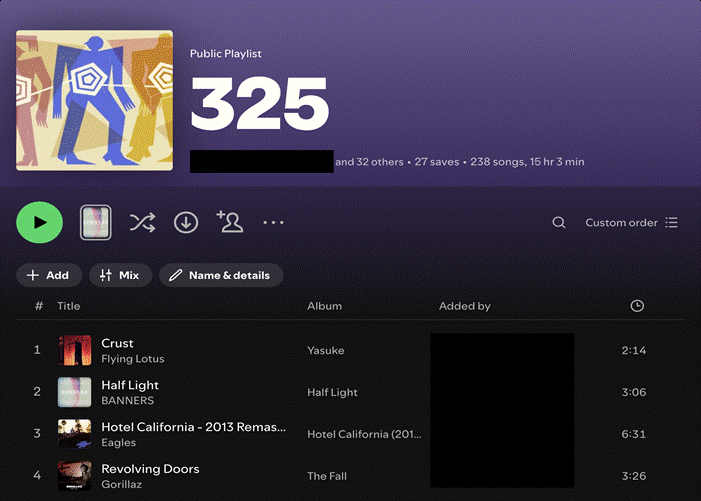
Figure 1. Example course playlist
Note: Identifying information has been redacted. Link to the actual playlist: https://open.spotify.com/playlist/5GkDCvlTJk5ohnXgTqCFMV?si=d5c79493615a467f.
Beginning with the second class meeting, I shuffle the playlist while students arrive. Music starts approximately 10 minutes before class begins and continues until the lesson starts. The playlist grows throughout the first week until every student’s song has been added, eventually becoming the soundtrack students hear as they enter class and take their seats each day. The activity requires only a few minutes to introduce, no additional class time after the first week, and virtually no preparation beyond creating the playlist.
Why it works
At first glance, this playlist may appear to be little more than background music. But the playlist functions as a subtle but meaningful signal that each student is represented in the classroom. Students often recognize when their song begins to play. These moments frequently spark conversations among students about their favorite artists, genres, concerts, or shared musical interests. The playlist becomes an easy conversation starter, particularly for students who might otherwise struggle to initiate social interactions in large group settings.
More importantly, the playlist communicates that every student has contributed something unique to the classroom environment. This fosters a sense of what scholars call ambient belonging, or the subconscious experience of fitting into an environment on the basis of physical or contextual cues. In this sense, having a shared playlist facilitates a classroom environment in which repeated, low-stakes cues consistently remind students that they are recognized, valued, and included (Cheryan et al, 2009; Allen et al., 2026). No single song transforms classroom climate, but hearing the collective soundtrack of the class over the course of a semester sends the message that everyone has a place here. Unlike many belonging interventions that require dedicated instructional time, this practice occurs during time that is often otherwise unused as students arrive and settle into class.
Implementation tips
First, establish expectations for appropriate song selections. Request clean versions when lyrics contain explicit language and reserve the right to substitute radio edits. Second, provide multiple ways for students to participate. Not every student uses Spotify, so offering a simple survey or email option ensures that everyone can contribute. Third, keep the playlist active throughout the semester. Repeated exposure, not simply passively collecting songs, is what gives the activity its value. Students enjoy anticipating when their song might play, and new conversations continue to emerge weeks after you’ve created the playlist. Finally, participate yourself by adding your own favorite song! This models the activity while allowing students to learn something personal about you, helping reduce social distance between instructor and students, while still engaging in appropriate self-disclosure.
Final thoughts
Instructors build belonging through countless, small interactions rather than a single transformative event. Although instructors often focus on active learning strategies that occur during class, the environment students encounter before instruction begins also communicates important messages about who belongs in the room. A collaborative, student-curated class playlist is an inexpensive, easy-to-implement practice that transforms otherwise idle pre-class minutes into opportunities for representation, conversation, and connection.
A potential unexpected benefit of this intervention is that the playlist becomes a durable, digital artifact of the course. Beyond the semester, the playlist serves as a lasting souvenir that students can take with them even after the term has concluded. Unlike many classroom activities that disappear when the term ends, students retain access to a shared artifact that may evoke memories of classmates, classroom experiences, and the learning that occurred alongside them.
By inviting every student to contribute to the soundtrack of the semester, instructors help to cultivate a classroom atmosphere in which students hear a recurring reminder that they are not anonymous participants but valued members of a learning community. Sometimes fostering belonging is as simple as pressing play.
References
Allen, K. A., Pitzer, A. L., Kuschel, S. G., Ma, L., Slaten, C. D., & Counted, V. (2026). A scoping review of social belonging interventions in higher education. Review of Educational Research, 0(0). 1–32. https://doi.org/10.3102/00346543261438478
Cheryan, S., Plaut, V. C., Davies, P. G., & Steele, C. M. (2009). Ambient belonging: How stereotypical cues impact gender participation in computer science. Journal of Personality and Social Psychology, 97(6), 1045–1060. https://doi.org/10.1037/a0016239
Hoseini Shavoun, A., Adeli, S. H., & Ahmari Tehran, H. (2024). Fostering engagement: A review of icebreakers in academic environments. Medical Education Bulletin, 5(2), 949–959. https://doi.org/10.22034/meb.2024.495642.1105
Wilson, J. H., & Wilson, S. B. (2007). The first day of class affects student motivation: An experimental study. Teaching of Psychology, 34(4), 226–230. https://doi.org/10.1080/00986280701700151
Alexa Jayne is an assistant professor of psychology at Regis University. Her research interests focus on the psychological factors that shape how people best learn, work, and thrive, with the goal of promoting healthy personal, academic, and career development.
The post Soundtrack of the Semester: A Simple Teaching Strategy for Enhancing Classroom Belonging via a Shared Music Playlist appeared first on The Teaching Professor.