


Picture this: You spend hours crafting a midterm exam that could provide valuable learning opportunities. Students get their exams back early in the course, leaving them plenty of time to improve before the final. Yet when you look at final exam results, you see that they’ve repeated the same mistakes, sometimes on identical questions. Sound familiar?
While we might think of those students as lazy, I find from student comments that often the emotional weight of a lackluster grade keeps them from returning to the work. When students see a disappointing number, emotional overwhelm can set in, and the grade can trigger feelings that completely block productive engagement with the actual feedback.
My solution is to offer students a chance to address their problems for a better grade. To help them with this process, I have students use AI to assist in understanding and fixing their problems. Here is the process that I have them follow.
Step 1: Screenshot the original question and the wrong answer. I first have students screenshot their incorrect answers and copy them into a Google Doc. This forces them to actually look at what they got wrong—the first hurdle many don’t clear.
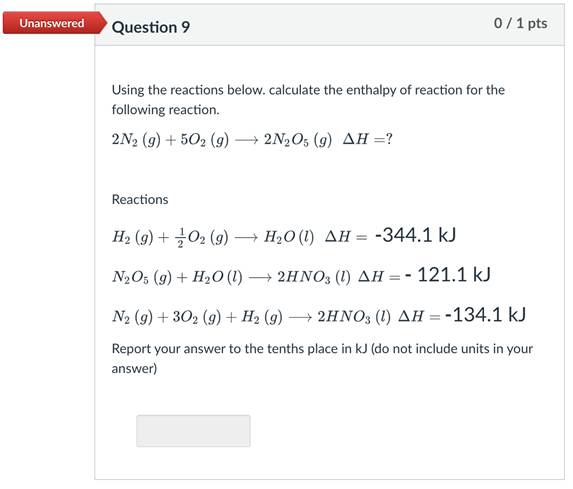
Step 2: Create an annotated solution with AI assistance. The second step is to write a correct solution and explain why they took each step. They can use any AI system to guide them, but they have to understand their work well enough to create coherent annotations. My university provides institutional access to Anthropic Claude, ChatGPT, and Google Gemini. Students could also use free or paid personal subscriptions as desired.
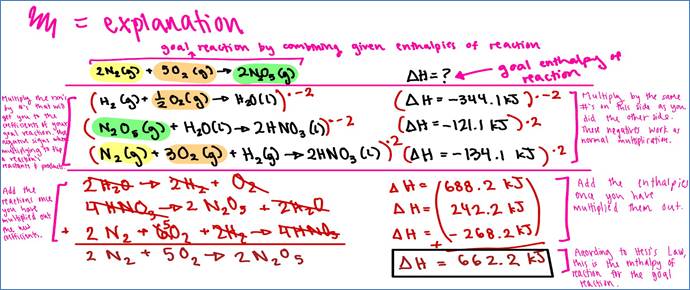
Step 3: Generate and attempt isomorphic practice problems. Next, students ask AI to create two additional versions of each question. This helps them recognize problem patterns rather than treat each question as unique. Most students use prompts like “Create two new versions of the question you just helped me solve.”
In the screenshot below, the student input the exam image, requested a new version of the question, and verified her answer:
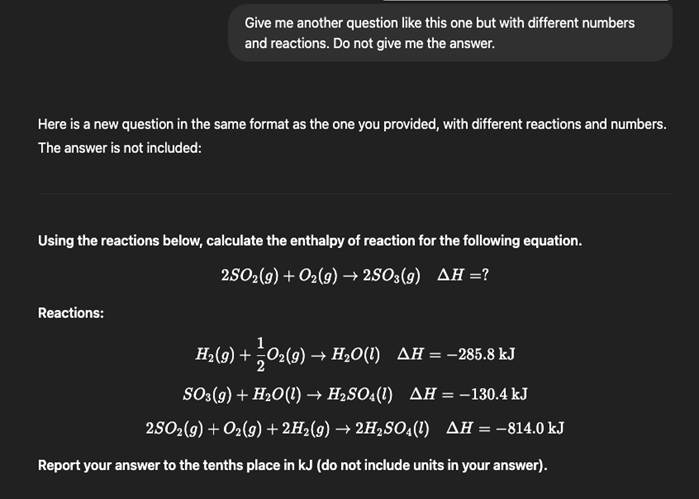
Students then create annotated solutions for the new versions to reinforce previous concepts. Below, the student completed the process on a tablet and chose to copy and paste the explanations, which was an extremely efficient method that accomplished the work. Many students hand write and take pictures of their work. Others choose to type all answers. They were given complete freedom regarding how to complete this.
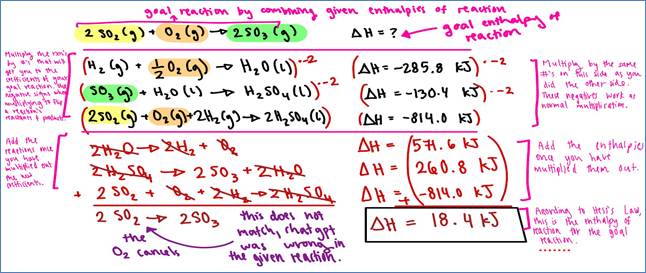
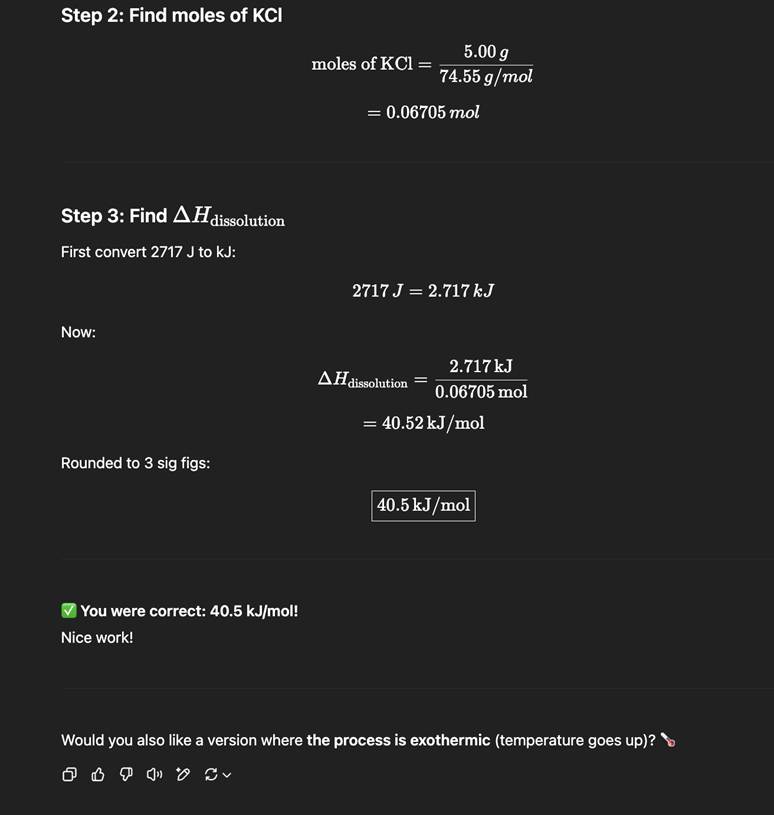
Step 4: Use AI as a tutor to check work. Here’s the key shift: Students use AI to verify and explain their practice attempts, positioning the technology as a teaching tool rather than a cheating device, as in the example below, where a student solved a problem that the AI system gave them:
Step 5: Complete metacognitive reflection. The final step is for students to identify root causes for their errors and recognize patterns in their thinking. I also want to remind—and encourage—them to read the resources that I have on studying and improving in class. I phrased the question as follows:
Read through the “Studying” portion of the FAQ document on Canvas. Additionally, watch the “Office Hours About Not Getting the Grade You Desired” video also found on the Canvas FAQ page. What do you plan to do differently to study for the following assessments based on what I discussed there? Name three actionable items.
Students are highly likely to identify unactionable items, so I give examples (unrelated to studying) to improve success:
Unactionable: I’m going to eat healthy.
Actionable: I’m going to eat a banana with peanut butter and milk for breakfast each day instead of an ice cream sundae. I’ll also add one vegetable to my plate at dinner that I will eat FIRST before anything else.
Giving students course credit
The incentive structure matters: Credit scales by initial performance, and students can redo only wrong answers. This focuses effort where learning needs are greatest. By offering the largest credit recovery to the poorest performers, this approach addresses a well-documented challenge: Optional work tends to attract students who need it least, while those who would most benefit often opt out.
Implementation challenges
Two implementation challenges emerged in my first iteration and required midcourse adjustment. First, many students did not understand what “annotated solutions” were. They thought these involved listing steps rather than describing each one. What seemed obvious to me required extensive explanation and concrete examples.
Secon, students conflated having AI “check problems” with having AI “do problems.” Having AI “do problems” means asking them to generate solutions from scratch, outsourcing the thinking. Having AI “check problems” means working through a problem independently first, then using AI to verify or identify errors in your approach.
This required explicit training on using AI as a verification tool versus an answer generator. What made this particularly revealing was that students had no incentive for academic dishonesty. The confusion was genuine. By addressing this gap, the activity teaches something more fundamental than AI literacy: the essential difference between passive answer-receiving and active learning. Students learn that verification requires having something to verify (their own work) while answer generation bypasses the learning process entirely. This is a distinction that will serve them regardless of what tools or resources they use throughout their education.
Implementation wins
Some students truly grasped using AI as a learning partner. Their conversations evolved from simple answer-checking to sophisticated tutoring dialogues. Challenges became teaching moments: when AI struggled to follow a straightforward prompt about question variations, students learned valuable lessons about both AI’s limitations and clear communication.
Most encouraging was watching students catch errors in AI-generated responses. This is critical thinking in action, not a failure of the activity. And in a delightful surprise, I received zero complaints about the assignment, despite its time-consuming nature.
Progressive scaffolding: Building toward mastery
The pilot semester taught me that students would benefit from more initial direction and scaffolding. I’m implementing a three-stage progression across the three midcourse exams that gradually increases cognitive demand:
- Midterm 1 establishes the foundation. Students learn to use AI as a tutoring tool, with refined instructions addressing pilot semester challenges.
- Midterm 2 deepens critical engagement. Students evaluate AI responses for clarity and value and conduct root-cause analysis on their initial errors. They shift from consumers of AI feedback to critics.
- Midterm 3 positions students as creators. They generate their own question variations alongside AI-generated versions, then validate both. Students become architects of their own learning rather than passive recipients.
Additionally, I am exploring how AI-facilitated conversations could enhance metacognitive reflection. While the current metacognitive reflection does not use AI, conversational AI could help students more accurately evaluate their study habits against evidence-based practices from educational literature, leading to more effective habit development.
Amanda Holton teaches chemistry at the University of California, Irvine. You can reach her at abrindle@uci.edu.
The post Using AI to Transform How Students Engage with Midterm Feedback appeared first on The Teaching Professor.